Acts 15

This is a significant moment. The early church was already stretched to an uncomfortable position. The work of God on Paul and Barnabas’ journey left a mostly Jewish church struggling with what to do with Gentile believers in the message and work of Jesus. Further, Peter’s encounter in Acts 10 had them wondering what to think about clean vs unclean. Their desire (rightly) was to do the will of God and to be righteous before Him! However, the question was starting to be raised, “What is most important in righteousness?” The Jews had blurred some lines that missed the mark. They were thinking that it was necessary to obey the law of Moses to be righteous, but now those who hadn’t (the Gentiles) were receiving the Holy Spirit and starting to follow Jesus. Did they need to be circumcised? What other parts of the law had to be followed as a sort of “entrance exam” to Jesus?

As they gather and discuss, the brother of Jesus, James, stands up and settles the matter – the law was impossible to follow and therefore should not burden the Gentiles. Paul will carry this even farther in his letters. So they set up that new believers would be best to follow Jesus teachings, avoid food given to idols, sexual immorality (both a practical thing and a break from sinful ancient worship practices with other gods), and blood. They all agree and the first council is concluded!

After this high point, Paul and Barnabas separate due to a disagreement about John Mark. John Mark had bailed on them in Cyprus (Acts 13:13). Paul didn’t want to bring him along on a second journey in case he bailed again. Barnabas wanted him to come along. So, Paul takes Silas and goes on journey #2. Barnabas and John Mark went back to Cyprus. They will work things out later.

Acts 14

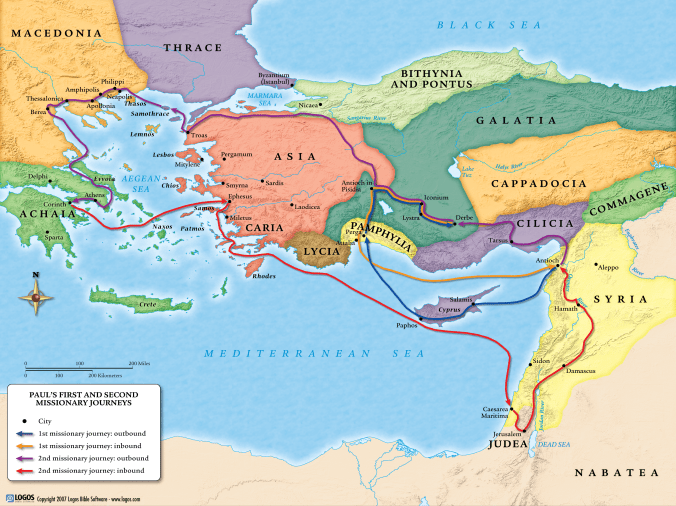
The end of the missionary journey (remember, the first the church did!) led Paul and Barnabas into some trouble. In Iconium, they deal with Jews trying to poison the minds of the Gentiles. The unbelieving Jews are going to become a problem as time goes on (watch for that).

In Lystra, the trouble comes from Paul and Barnabas calling out the pagan practices of the worshippers of Zeus. This creates a problem and Paul is stoned by the crowds. While some think this sounds like fun, it is not that kind of stoning. People would grab larger rocks and pelt the victim until they were a bloody mess and left for dead. The disciples of Jesus surround him and pray and Paul gets up, goes back into the city and heads to Derbe to preach some more! One key of this journey was not just preaching the Word, but setting up elders in each church so that it will survive. These men likely were quick believers that put the pieces together from the Old Testament about Jesus. They were steadfast and ready to lead and mature believers by the time Paul and Barnabas left. This incubation period takes a bit longer today for many of us. Partially because we are starting from a more basic starting point. This doesn’t mean it can’t or doesn’t happen! This process is called discipleship.

As they go along, they make their way back to where they started, can you imagine how excited the church was to 1) have them back and 2) rejoice in the news that many churches were started by the work! Amen and amen!

Acts 13

The church in Antioch starts the first missionary trip. Up until now the church has been spread due to persecution or other factors. This is the first time that we see a church praying for what God wants done, giving resources as He leads and then sending a group to accomplish the mission of God! Saul and Barnabas are sent off and start a journey to Cyprus (an island in the Mediterranean). They encounter a magician and God takes his sight by a mist of darkness – which is incredible. They then got on a boat and headed to Pamphylia. Then to Pisidia (which had a different Antioch) and through parts of the region of Galatia and ultimately to Derbe. Then the band tracked back and ended up back at Antioch (next post will deal with some of this journey). See the map below from my Logos software. I love Logos!

Note Saul’s name and usage of the Old Testament in sharing the message of Jesus! He is preaching to Jewish audiences at various synagogues. Therefore he goes by Jewish methods and understandings. We must know who we are talking to and what they need to understand about Jesus. Here in America, part of that may be to redefine who the Messiah is to us and helping people see what Jesus is really about. By the end of the journey he goes by Paul (in Gentile land) and shares the message that God is the hope (light) to the Gentiles as well. They rejoice and are excited to surrender to God!

1 and 2.png

Acts 12

As the church grows outside Israel, the church within Israel suffers under the hand of Herod. Herod has James, son of Zebedee and brother of John (writer of John and Revelation) killed by the sword and puts Peter in jail. Peter was asleep in jail (remember John 21!) when suddenly he is released by God’s mercy. He passes the guards and the gate opens itself (what!?!?) and he makes his way to John Mark’s mom’s house. The servant girl, Rhoda, is so excited that it is Peter, she doesn’t open the gate but runs inside excited. Peter eventually gets into the house after knocking a lot. Herod has the guards put to death and leaves Judea to return to Caesarea.

Herod dies and the church grows. I like that reality. Nothing stops God’s church from growing and spreading like wildfire.

Acts 11

Peter’s amazing experience with Cornelius leads him to go back and tell the church exactly what is going on “out there.” The bridge was being built! God cared for the whole world and the idea that He only loved the Jews was a wrong ideal and mentality by the Jewish people. God had chosen Abraham and blessed him “to be a blessing to all people.” God was setting things straight and moving mankind back to where they were meant to be.

The key of Peter’s report is when the others who hear Peter’s report that “If then God gave the same gift to them (Gentiles) as he gave to us when we believed in the Lord Jesus Christ, who was I that I could stand in God’s way?” they reply “Then to the Gentiles also God has granted repentance that leads to life.” Oh, God had plans to save them too! We think, “Duh” because we are recipients of this thinking. We are Gentile followers because of the grace given to us. This was radical at the time because the Jews had misunderstood their place in history. I believe we still do this today, unfortunately. We decide to do things our way instead of God’s way and it misses the mark.

The chapter ends with a spontaneous church breaking forth in Antioch. This becomes significant because Barnabas and eventually Saul/Paul settle in at this church. Here is where the followers of Jesus are first called “Christians” or “little Christs.”

Acts 10

Cornelius (another centurion – look at Luke 7) has a vision and seeks out Simon Peter.

Simon Peter has a vision of unclean and common animals on a sheet.

What happens next is huge. God says “what God has made clean, do not call common.” Peter refuses to eat what he thinks shouldn’t be eaten. God pushes back and says that He has made things clean. This happens three times, which has some significance (3 denials, 3 reassurances in John 21) and shows Peter that God has changed things. The Jewish people had taken the idea of God’s clean/unclean concepts to mean that they were to be separate from the world, when God wanted them to be different. They were meant to be different, not separate. God’s pushback to Peter’s understanding leads the church to a new path. The moral/cultural aspects of the law begin to fade away. Not because the law was abolished, but because the law was fulfilled. In Christ, we are made clean. In Christ there is no need to “satisfy” God. He has made all things clean. This is huge! So many today think aspects of the law still hold us. The apostles teaching will begin to drive to an Acts 15 decision that begin to unravel the real significance of Christ and what He has done! This will be spelled out more in Romans, etc. Be ready!

When the Holy Spirit descends on Cornelius’ whole household as they believe in Christ, Peter is left wondering what God is doing. He was just getting started!

Acts 9

Saul has a miraculous conversion. God’s “greatest enemy” becomes the biggest proponent of infusing Gentile believers into the message of Jesus. He is an advocate to grace and sets the tone well for the church today. Here’s how it goes down:

Saul was heading to Damascus to persecute “followers of the Way” and arrest them and bring them to Jerusalem. Instead of this, he is blinded by a light and forced to talk to a voice that ends up being Jesus. He had no sight for 3 days and neither ate nor drink. Ananias, a follower of Jesus, is told by Jesus to go pray with Saul. He asks Jesus if He is sure (Saul is dangerous). Jesus responds that Saul is chosen to be God’s instrument. Saul is prayed over and regains sight, scales fall off his eyes and he begins to proclaim Jesus publicly – in Damascus! This causes people to want to kill Saul. He escapes and Barnabas brings Saul along and welcomes him into the new church. From this, Peter is brought back into the story and Luke gives some interesting information concerning Gentile believers starting in chapter 11.

However, Saul/Paul and Peter are the key players in the pages to come and Paul becomes the main character that serves Jesus and spreads the word. While the story in Acts is played out, Paul writes nearly all the letters we have in the books to come. The story speeds up big time!

Acts 8

A very ominous first line of chapter 8 gives us introduction a character that will dominate the rest of the New Testament. Saul. Saul, a native of Tarsus and a Jewish Roman citizen, trained by Gamaliel and passionate for God to a fault (he will admit as much later). Saul is a huge character. Let me take just a few moments to clarify a couple things. There is a biopic coming out this year and these things always make me a little afraid, as details get added or misunderstood. I’m looking forward to seeing it, and don’t know if any of these “problems” will come up, but I’ll deal with them here just in case.

Saul’s name didn’t change.  Many teach that “Saul” became “Paul.” That seems logical, but it is mistaken. The reason Paul is used more later is the audience that Paul is writing to. Paulus is his family name (like Stukenberg is mine). It would give street cred (as the kids say) for Paul to the Gentiles he is writing to. It shows his standing (a Roman citizen) and allows him access to things other Jews would not have (or want for that matter). So, in Jewish circles, Saul would be his used name. In Gentile circles, Paul would carry him.

Saul/Paul was well-trained as a Pharisee. Gamaliel showed up in Acts 5 (v34ff) and was well-regarded by other Pharisees in the day. Saul claims to have been taught by him, so he was taught by the best of the best! This means Paul had a good understanding of the Bible (perhaps even had most of what we call the Old Testament memorized) and could hold his own in many religious circles (which will bode well in a number of ways). The early church relied on his teaching, knowledge and helpful understanding of the Bible and how it informed the church – especially in a Gentile setting!

Saul was a murderer. He didn’t feel this way, of course. He felt he was serving God and therefore snuffing out a false religion. However, he was wrong and changes sides in Acts. The statement, “And Saul approved of his execution” (Acts 8:1a) shows us where he is at in his heart and status as a worshipper of Yahweh. 8:3 shows us that he does not stop there and carries this all the way through the church as much as he can. He was a bad dude.

Saul was likely a widower. He makes some unique statements in his letters that seem to suggest he was married at one time. These will be highlighted by me when we get to them. It is curious though and leaves you wondering what happened. Does she leave him when he follows Jesus? Did she die before? We have no idea (or even that he was for sure). However, Saul/Paul being free of the marriage covenant leads him to some ridiculous places as a follower of Jesus and a new leader of the fledgling church. He would not have been able to travel so extensively (in that day) if married. He traveled over 25,000 miles in his life – which was unheard of! He then feels he can say “be as I am” in 1 Corinthians concerning marriage, as he was single.

Saul is a huge character. His first interaction with the church is to help start the persecution (8:1-3) that ultimately pushes the church out of Jerusalem and into Judea and Samaria (check 1:8 for why this is significant!).

This happens quickly by following an apostle named Philip. Philip was a farmer and was challenged by Jesus to find food to feed 5000. Philip goes to Samaria and challenges a guy named Simon to give up his ways to follow Jesus. Then he shares the message to the Ethiopian eunuch and the Ethiopian church still claims that this event, sparked with the interaction between Solomon and the Queen of Sheba led to their birth and the first Christian nation!
 

Acts 7

Stephen’s speech is amazing and shows just how wise these deacons were. Again, I think many today miss how key a role deacons were/could be in the church. So many of us set the bar quite lowly for ourselves and think “I’m not aiming for elder level or church leadership level, so it’s okay to just hang here where I am at.” The problem with this thinking is that our “mark” is Jesus, we are aiming to Him! We read and learn the Bible to become more like Him. We pray following His example. We love people and live a life of worship because He modeled it for us. I could go on, but the idea here is there are no “levels” but we should be pursuing Christ with all we have. He will change us, He will make us “qualified” to serve the church. Further, even if we do not aspire to leadership in the church, we should be qualified to be so if we are chasing after Jesus.

Look at how Stephen walks through the biblical narrative and shows Christ in it all! Clearly the early church sought to share the gospel from start to finish – not just “pray a prayer and get into heaven.” They sought to give some clarity as to Jesus’ claim to being Messiah. They wanted people to know and then make up their minds.

Stephen’s speech ends in his martyrdom (witness to the point of death). This is going to be a common occurrence in Acts. However, people are still dying for their faith today. Let’s pray for those putting their life on the line today. Let’s pray that they have the courage to hold to the Gospel in the face of certain death. Let’s pray for their families and the outcomes of such deaths. Let’s pray for our own boldness that we would share the Gospel and not be afraid of the consequences.

Acts 6

The first real issue arises for the church. Some widows are not getting cared for. It seems to be a racial problem. Instead of continuing to worry the Apostles with this busy work, they declare 7 men to carry the load and carry out the work of making sure the church is doing its work. I think this is amazing!

I also struggle with it because so often today the position of deacon/caretaker/etc is filled by men who see it as a lesser role than elder. Yet these men were considered to become deacons because they were just as “worthy” as the apostles. They are leaders who know the Word and are leading the church.

One of these guys, Stephen is arrested and this sets the tone for the following few chapters. Partially because a guy named Saul gets involved. Saul is a name for a king, Israel’s first king. Both were from the tribe of Benjamin. Both are huge characters in the Bible. One story is redemptive, the other not so much. More on him later!